






PAVING MEGA CLEARANCE: UP TO 42% OFF. READY STOCK, 48HR DELIVERY.
LEARN MORE
Yellow Limestone Paving
Yellow limestone paving brings warm, natural tones to outdoor spaces in a way that few other stones can match. With colours ranging from soft buff to deeper golden hues, this is a natural stone paving slab category that suits a wide range of UK garden styles, from traditional cottage settings to contemporary patio designs that benefit from warmer, earthy tones.
Limestone is a sedimentary stone formed over millions of years, and the yellow and golden varieties often carry fossil imprints, subtle shell markings, and tonal variation that make each slab distinct. This natural character is part of what draws many homeowners to it rather than more uniform alternatives.
At Nustone, yellow limestone paving is available as part of our wider natural stone paving slabs range, alongside other limestone colours, sandstone, slate, and granite options.
✅ Warm golden, buff, and yellow tones that complement natural garden settings
✅ Fossil markings and shell imprints common in many limestone varieties
✅ Natural tonal variation across slabs, giving each installation a unique appearance
✅ Sedimentary stone structure with a relatively smooth riven or sawn surface depending on finish
✅ Suitable for patios, garden paths, and outdoor entertaining areas where appropriate
✅ Available as natural stone paving slabs in a range of sizes
Showing 1–6 of 6 products
 3 variants
Yellow Indian Limestone Paving Slabs - Patio Kit - 22mm
From £32.462 variants
Yellow Indian Limestone Paving Slabs - 600x900 - 22mm
From £29.93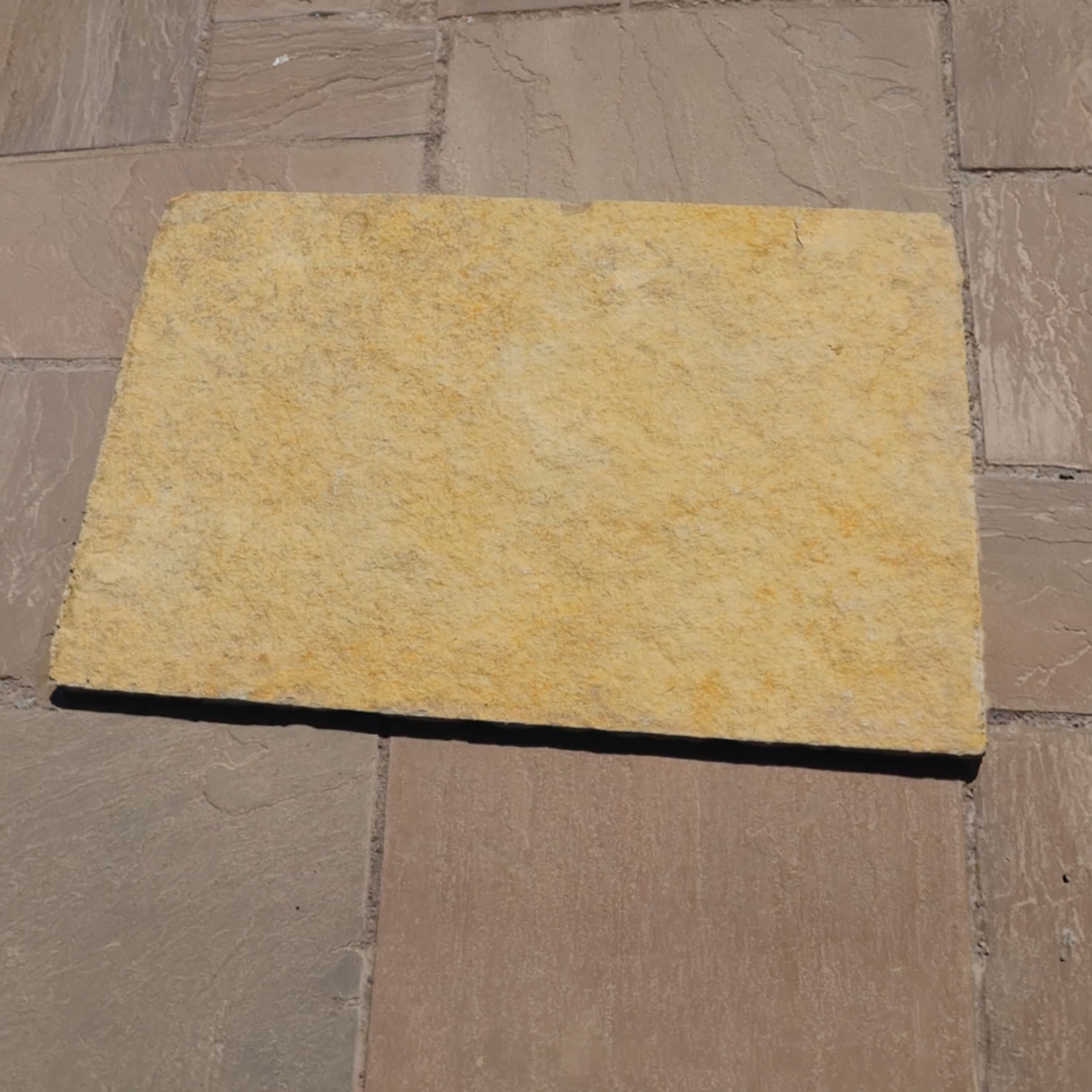 2 variants
Yellow Indian Limestone Paving Slabs - Sawn Edges - 600x900 - 22mm
From £30.59 3 variants
Yellow Indian Limestone Paving Slabs - Sawn Edges - Patio Kit - 22mm
From £33.11 2 variants
Yellow Indian Limestone Paving Slabs - Tumbled - 600x900 - 22mm
From £30.29 3 variants
Yellow Indian Limestone Paving Slabs - Tumbled - Patio Kit - 22mm
From £32.72
Why Choose Yellow Limestone Paving?
The appeal of yellow limestone is largely tonal. Where grey granite or blue-black slate create cooler, more formal spaces, yellow and golden limestone introduces warmth into an outdoor area. This makes it particularly well-suited to gardens with planting schemes built around warm colours, or to south-facing spaces where the stone can catch direct sunlight and shift in appearance through the day.
Many customers also choose yellow limestone for its character. Because it is a sedimentary stone, fossil impressions, shell shapes, and natural markings are common. These features are not uniformly present across every slab, but they occur naturally through the material and add interest to finished patios that cannot be replicated in manufactured surfaces.
Natural stone paving slabs, including limestone, also tend to weather gradually and develop a patina over time, which many homeowners find preferable to the way synthetic materials age.
Understanding the Yellow, Golden and Buff Tonal Range
Yellow limestone paving covers a tonal spectrum rather than a single fixed colour. The terms yellow, golden, and buff are often used interchangeably, but they describe slightly different appearances within the same family of stone.
Yellow limestone tends to show the clearest, warmest yellow tones, often appearing brighter in direct sunlight. Golden limestone sits in the mid-range, with amber and honey-coloured tones that shift between yellow and brown depending on lighting. Buff limestone describes a softer, more muted palette, with pale cream and sand tones that work well in more understated garden designs.
Because limestone is a natural material, individual slabs within a single batch will show variation. Some slabs may be lighter, others more golden or ochre in tone. This variation is a characteristic of natural stone rather than an inconsistency, and it is one of the reasons ordering samples before committing to a full project is particularly useful when selecting limestone.
Limestone in UK Gardens: Light and Seasonal Appearance
One practical consideration for UK gardens is how paving performs visually in both bright and overcast conditions. Yellow limestone has a quality that many homeowners find useful in this regard: its warm tones remain visible and readable even in lower light, whereas cooler grey stones can appear flat or dull on overcast days.
In direct sunlight, lighter buff limestone can reflect warmth in a way that makes an outdoor space feel more open, while deeper golden tones add richness without overwhelming a planting scheme. This makes the yellow and golden limestone range a practical choice for UK climates where light levels change considerably through the year.
Because the stone is natural, its appearance will also shift slightly when wet. Most limestone darkens a little in rain, which can actually enhance the depth of colour in the golden tones. This is expected behaviour for natural stone paving slabs and not an indication of a surface problem.
Natural Variation and Fossil Character
Yellow limestone's sedimentary origins mean that fossil fragments, shell impressions, and organic markings are often visible within the slabs. These are not always consistent across every piece, and their presence and clarity will vary. Some slabs may show clearly defined shell shapes; others may show subtle veining or grain patterns without visible fossil content.
This natural character is part of what distinguishes limestone from more uniform paving materials. If you are looking for a completely consistent, repeating surface, limestone may not be the right choice. If you want a natural stone patio that changes in character as you move across it, yellow limestone provides exactly that.
The irregular nature of the material means no two installations are the same, which is one of the reasons many landscapers and garden designers continue to specify limestone for projects where character and authenticity are priorities.
Durability and Maintenance Considerations
Limestone is a moderately durable natural stone, but it is worth understanding its properties before use in outdoor settings. As a calcareous stone, limestone can be sensitive to acidic cleaning products. Avoid cleaners containing acids, vinegar-based solutions, or anything not specifically designed for use on limestone or natural stone, as these can damage the surface.
Limestone is also naturally porous to varying degrees depending on the specific stone. Sealing yellow limestone paving with an appropriate natural stone sealer is generally recommended to help resist staining, reduce water absorption, and preserve the surface over time. Sealing is not a permanent fix and will need to be reapplied periodically, but it significantly extends the practical lifespan of the installation.
For frost resistance, check the specific product guidance, as the density and composition of limestone can vary. Correct installation, including adequate base preparation and appropriate jointing, is important for the long-term performance of any natural stone paving slab, and professional installation is recommended where appropriate.
Where Yellow Limestone Paving Works Best
• Garden patios in traditional or cottage-style settings where warm stone tones complement the surrounding planting
• South or west-facing spaces where the stone will be exposed to sunlight and the warmth of the colour is most visible
• Gardens with warm planting palettes: oranges, yellows, rust tones, grasses, and Mediterranean-style planting schemes
• Paths and walkways where the natural tonal variation adds character to the route through a garden
• Outdoor dining and entertaining areas where the warmth of the stone creates a comfortable atmosphere
• Spaces where the homeowner wants a stone that looks distinct from the standard grey porcelain paving tile
Yellow Limestone vs Related Paving Options
Yellow limestone vs sandstone
Both are natural stone paving slabs in warm tonal ranges, but they behave differently. Sandstone is generally more robust in terms of frost resistance and is commonly used across UK climates. Yellow limestone tends to show more tonal variation within a slab, and fossil character is more likely. If you are drawn to warm tones but want a more reliable performer in exposed northern UK conditions, sandstone may be the safer option. If you want the fossil interest and geological character that limestone provides, and are willing to maintain it carefully, limestone is worth considering.
Yellow limestone vs warm-toned porcelain
Warm-toned porcelain paving offers a contemporary stone-effect look in similar colour ranges to yellow limestone, but with considerably more uniformity, lower maintenance requirements, and better frost resistance. Porcelain will not have the fossil character or the tonal depth of genuine limestone, and the surface texture is different. Customers choosing yellow limestone are generally doing so precisely because they want the qualities that porcelain does not have: variation, fossil content, and the visual depth of natural stone.
Yellow limestone vs other limestone colours
Nustone offers limestone paving in a range of colours beyond the yellow and golden spectrum. Customers looking for a cooler, more neutral palette may prefer silver-grey or blue limestone options. Yellow limestone is specifically suited to those who want warmth as the defining characteristic of their patio stone. If you are unsure between limestone colours, samples are the most reliable way to compare tones in the context of your own garden.